December 2025 Newsletter
To close out an exciting year, this issue will focus on the advancements made across the board of drug development, including an in-depth look on clinical trials to date.
Science in Sixty Seconds
Neurotherapeutics: Designing What’s Next
2025 has been full of big news, really demonstrating neurotherapeutics are at an inflection point. Psychedelic clinical trials continue to provide insights and open doors, but are not enough. With challenges of safety, reproducibility, clinical scalability, and differentiation between interventions, progress is stalling and treatments aren’t reaching people. Real innovation is shifting toward rational design, selective mechanisms, and precision biology. Xylo Bio is proud to be part of that shift.
Below, we highlight the current state of neuropsychiatric clinical trials underscoring the need for translationally relevant drug design and precision medicine.
Snapshot: Psychedelic Trial Congestion
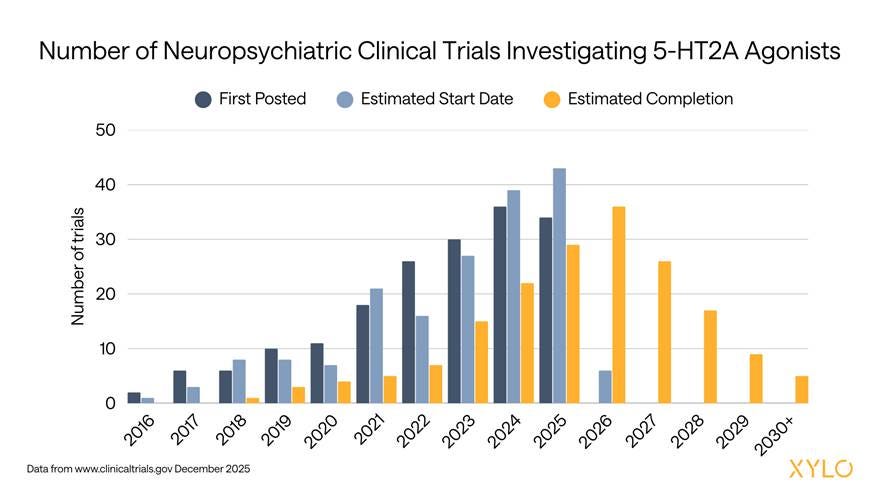
- Since 2016, 179 clinical trials involving 5-HT2A agonists for neuropsychiatric diseases have been registered on clinicaltrials.gov.
- 76 of those trials are either sponsored by industry or are collaborations with industry.
- 2025 was the highest-volume year on record for study start dates with 80 studies slated to begin.
- Psilocybin accounts for more than 60% of all trials, spanning dozens of indications.
Note: These numbers are from our own search and exclude trials categorised as ‘suspended’, ‘terminated’, or ‘withdrawn’.
These numbers highlight the scientific energy in the field and the increasing competition within the psychedelic space. Investigations into psychedelics are increasing, but volume does not always correlate to innovation. For example, with large amounts of studies on psilocybin for Major Depressive Disorder (MDD), several of these clinical trials suggest redundancy and attempts to circumvent the regulatory scrutiny psychedelics research faces. For companies pursuing undifferentiated serotonergic agonists, standing out is becoming increasingly challenging.
Why this matters: Beyond the psychedelic paradigm
In the larger research space, there are over 1,700 clinical trials registered investigating a variety of neuropsychiatric and related indications outside of psychedelics. Investigation of 5-HT2A agonists and psychedelics only makes up 10% of the clinical trial landscape, yet it’s incredibly repetitive – and competitive. With an oversaturated market and clinical delivery bottlenecks, there is a need for biologically-informed mechanistic drug design rather than the precedence of the phenotypic driven discovery.
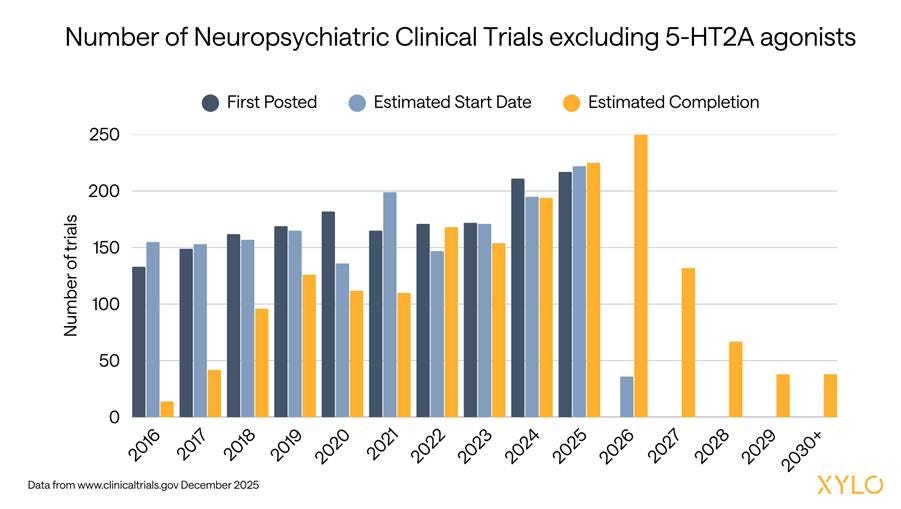
This point is demonstrated by this large number of trials from early phase to phase 3. There hasn’t been very much improvement or creativity in neurotherapeutics. The most notable developments in the last 10 years are:
● Spravato (Esketamine) – Rapid-Acting Nasal Spray that acts on the glutamate NMDA receptors. This was expanded in 2025 to be used as a standalone treatment for adults with treatment-resistant major depressive disorder (MDD).
● Exxua (Gepirone) – An orally administered analog of anxiety medication, buspirone, that acts on the pre- and post-synaptic 5-HT1A receptors. This was FDA approved in 2023 and available in 2024.
● Caplyta (lumateperone) – An orally administered atypical antipsychotic that’s mechanism of action is unknown but acts on a variety of dopamine, serotonin and glutamate receptors. This was FDA approved in 2025 as an adjunct to other MDD treatments.
● Flow Neuroscience FL-100 – An At-Home Brain Stimulation Device that utilizes transcranial direct current stimulation (tDCS) to deliver mild electrical currents to mood-related brain areas for treatment of MDD.
● Rejoyn – An FDA-approved prescription smartphone app that features CBT-based exercises and engagement features to offer scalable support for MDD patients.
While promising, many of these aren’t going to cut it. Many people are not responsive, have experienced unwanted side effects, or aren’t sure how to access these new technologies. It’s obvious the neuropsychiatry space is crowded and even novel pharmacotherapies outside of psychedelics are losing creative steam. By relying on iterations of legacy scaffolds, the field is ignoring opportunities for advancement.
At Xylo, we recognize the next breakthrough in neurotherapeutics will not come from additional iterations of classic psychedelics or anti-psychotics, but from selective, rationally engineered neuroactive compounds. While much of the field is clustered around a small set of well-characterized psychedelic scaffolds, we are focused on:
● Next-generation GPCR drug design
● Biomarker-guided translational biology
● Tunable pharmacology to avoid hallucinogenic mechanisms and off-target activity
Through innovative chemistry and rigorous targeted therapeutic design, we can develop treatments tailored to addressing the complexity of neuropsychiatric disease with mechanism-based biology at the core. Learn more about Xylo Bio below.
XYLO BIO UPDATES:
The Science:
Our lead candidate XYL-1001 will be starting first-in-human studies in 2026! We are thrilled for the new year and all that it has in store.
Scientific Leadership
- We are excited to welcome Catherine Weenink as our Senior Director of Clinical Operations.
- Dr. Bryan Roth has joined the team as an advisor, providing expertise in GPCR biochemistry and pharmacology.
Collaborations and Thought Leadership
- PET imaging insights discussed in our latest Targeted Neuro Talk with Drs. Sam Banister and Mikael Palner.
- Co-founders Josh Ismin and Dr. Sam Banister had a long visit in NYC that included attending the Endless Frontiers Program at NYU Stern and meeting with several colleagues and potential partners.
- Our team of scientists and chemists including Drs. Will Jorgensen, Lachlan Whish and Nick Everett, met with research partners Tessara Therapeutics, and USYD to track progress in research into substance use disorders. Link here.
- The Royal Australian Chemical Institute Medicinal Chemistry and Chemical Biology Symposium featured Xylo’s Dr. Will Jorgensen as a panelist.
- The Drug Discovery Symposium at the Centre for Drug Discovery and Innovation featured Alex Athanasopoulos, PhD Candidate in our partner lab at USYD in a panel discussion. Link here.
- The implications of AI in everyday life discussed on Peter Ostick’s When (A)I Grow Up podcast featuring CEO Josh Ismin.
- A recent publication focused on psilocybin, sex differences and neuroplasticity by Xylo Head of Communications was published in Nature Communications.
- The IEEE Engineering in Medicine and Biology Society (EMBS) Meeting featured Xylo’s Director of BD Samantha Tabone as a panelist.
Coming Up:
You can find members of the Xylo team at some of the top conferences in neuroscience, technology drug discovery and healthcare.
- J.P. Morgan Healthcare Conference (San Francisco, USA, January 12-16) – CEO Josh Ismin, Director of Business Development Samantha Tabone, and VP of Research & Development Jack Nguyen will be attending.
- American College of Neuropsychopharmacology Annual Meeting (Paradise Island, Bahamas, January 12-15) – CSO Dr. Sam Banister will be attending.
- Psychedelic Therapeutics and Drug Development Conference (New Orleans, USA, February 26-27) – CSO Dr. Sam Banister will be speaking.
- International Society for Research on Psychedelics (ISRP) (New Orleans, USA, February 27-March 1) – several members of Xylo Bio will be attending.
- Join the Team
● Chair, Clinical Advisory Board
Photos

RESEARCH UPDATES: Science Shaping the Future of Neurotherapeutics
This month’s emerging literature demonstrates the same principles driving Xylo’s strategy: mechanism-guided design, rigorous biological investigation and clinically scalable innovation.
Preclinical Research
● Sodium alters opioid receptor conformation to effect signaling | This study explores how sodium ions affect two types of opioid receptors, μ (MOR) and κ (KOR), which are involved in pain relief and mood regulation. Researchers found that sodium reduces the activity of MOR but boosts the signaling of KOR, showing that sodium impacts these receptors differently. These findings could help improve the design of drugs targeting opioid receptors for pain management and mental health treatments. Biochemistry.
● Prolintane analogs alter monoamine transporters across species| This article explores new analogs of Prolintane, a synthetic stimulant, and investigates how these analogs interact with the brain’s monoamine transporters that regulate neurotransmitters like dopamine, serotonin and norepinephrine. Researchers identified structural variations that influence how strongly the analogs bind, potentially affecting their stimulant effects. Their work could help guide safer or more targeted compounds by clarifying how modifications change transporter interactions. J. Biol. Chem.
● Developing biased agonists for the 5-HT1A Receptor | The serotonin 1A receptor (5-HT1A) is very important in regulating serotonin and contributes to behavioral inhibition, thus making it a target of interest for new antidepressants. In this article, researchers mapped how the 5‑HT1AR works at the molecular level and then engineered a new drug that activates a specific signaling pathway of that receptor (GoA-preferential pathway). In mice, this selective agonist produced rapid antidepressant effects without activating autoreceptor functions of 5-HT1AR, which can limit the effectiveness of traditional antidepressants. Cell.
● Psilocybin produces sex-specific changes in behavior and plasticity | Serotonin 2A is involved in the hallucinogenic effects of psychedelics, but it’s unknown whether it’s involved in the anti-addictive properties. After a single dose of psilocybin, researchers found rewarding properties of an opioid were reduced but only in male mice. This effect required activation of 5-HT2A receptors in the frontal cortex specifically projecting to the brain’s reward center. Further, psilocybin had inverse effects on structural neuroplasticity and epigenetic landscapes in male and females. Nat Comms.
● Plasticity effects of psychedelics may be independent of structural plasticity | Plasticity is a major player in everyday life and thought to be the driver of novel rapid-acting antidepressants. In this study, authors report that a single dose of psilocybin or selective 5-HT2A agonist, 25CN-NBOH, produces antidepressant-like behavioral effects that last at least three months. These long-lasting effects were associated with durable changes in functional plasticity, but not with changes in structural plasticity. This suggests psychedelics’ lasting benefits come from altering brain cell function rather than altering their physical structure. Neuropsychopharmaacol.
● Psilocybin triggers an activity-dependent rewiring of large-scale cortical networks | Psilocybin reshapes how different parts of the brain communicate by strengthening some pathways and weakening others, and this rewiring depends on which neurons are active during the drug experience. In mice, the drug boosted connections that send sensory and default-mode-related signals to deeper brain regions, while weakening the usual feedback loops between cortical areas. This activity-dependent shift in network wiring may help explain how a single psilocybin dose produces long-lasting therapeutic effects. Cell.
Clinical Research
● Transcranial ultrasound stimulation targets deep brain regions | Transcranial Ultrasound Stimulation (TUS) is a non-invase technique that sends focused ultrasound through the skull to targeted brain regions. In a group of healthy adults, researchers were able to reach the nucleus accumbens and effectively measure how stimulation in this area alters how people learn from rewards and make decisions. Specifically, after TUS participants showed changed brain activity in the NAcc and surrounding areas and displayed increases in “win-stay” behavior. This suggests a viable, non-invasive way to modulate deep-brain circuits. Nature Comms.
● Computational modeling reveals brain mechanisms related to self-prioritization in aging | The study found that older adults, despite general age-related slowing, maintain and even enhance their ability to prioritize information about themselves compared to others, a phenomenon called “self-prioritization.” Through fMRI and computational modeling, the authors show this preservation happens via different brain mechanisms in older adults. While overall response speed slows with age, the brain doesn’t have a uniform decline and instead rewires to preserve important functions. J Neurosci.
● PTSD treatment outcomes associated with attentional capacity | Prolonged exposure therapy is considered the golden standard for PTSD treatment, but comes with high dropout rates which are thought to be due to the intensity of therapy. This study examined how sustained attention plays a role in therapeutic outcomes during exposure therapy. The authors found that individuals with better baseline attention showed slightly greater reductions in PTSD symptoms across both prolonged exposure therapy and prolonged exposure combined with sertraline. Importantly, adding sertraline did not change this relationship. Psychother Res.
● Cortical folding patterns associated with major depression |In this study, researchers assessed alterations in functional and effective connectivity in first-episode drug-naive MDD patients. They found that people experiencing their first episode of major depression show reduced cortical folding in parts of the anterior cingulate cortex and orbitofrontal cortex, which are linked to problems with attention, working memory, and processing speed. Notably, the affected brain regions overlapped with areas rich in serotonin, dopamine, acetylcholine, and histamine receptors, suggesting that early-life neurotransmitter disruptions may shape brain development in ways that increase vulnerability to depression. Prog. Neuropsychopharmacol. Biol. Psychiatry
● Psilocybin alters contextual computations within the visual cortex | This article explores how psilocybin changes how people visually perceive context. After administration of psilocybin, participants experienced a stronger version of the Ebbinghaus illusion (i.e. objects looked more distorted by their surroundings). Brain imaging further revealed that psilocybin reduces surround suppression in the early visual cortex. This means the brain’s usual way of dampening background context is weakened. This study provides a deeper look into how psychedelics are altering visual perceptions. Nat Comms.
Editorials and Reviews
● Enhancing clinical translation of analgesics for neuropathic pain: a systematic review and meta-analysis on the role of non-evoked pain assessment in preclinical trials |This article reviews decades of animal studies for neuropathic pain. When researchers include measurements of spontaneous non-evoked pain, rather than just reflexive responses, the effectiveness of standard pain drugs in animals matches what’s seen in humans. This suggests that testing for “real” pain behavior in preclinical trials, rather than reflexive or induced pain, could improve the odds for novel translational pain treatments – possibly helping close the longstanding gap between lab successes and clinical failures. PAIN.
● What Do Oral Drugs Really Look Like? Dose Regimen, Pharmacokinetics, and Safety of Recently Approved Small‑Molecule Oral Drugs | The authors reviewed many recently approved oral small-molecule drugs and found that, even though drug developers often aim for once-daily low-dose regimens, a large fraction of new drugs end up requiring multiple daily doses. This could be due to high clearance, strong binding to blood proteins, or low oral bioavailability. They argue that to find and develop safe, effective oral medications, drug-discovery scientists should be more flexible and realistic about what “good” pharmacokinetics can look like, instead of insisting on overly narrow criteria that may exclude otherwise useful compounds. J. Med. Chem.
● Investigating hierarchical critical periods in human neurodevelopment | Human beings experience a variety of critical periods throughout development. These windows happen over childhood and adolescence when different brain regions are especially sensitive to environmental experiences. Understanding these periods could help pinpoint when young people are most vulnerable to environmental stressors — but also when positive interventions might have the biggest long-term benefit. Neuropsychopharmacol.
● Targeting synapse function and loss for treatment of neurodegenerative diseases | A common, and perhaps underappreciated, driver of many neurodegenerative diseases like Alzheimer’s and Parkinson’s Disease is the dysfunction and loss of synapses. The authors review recent discoveries about how synapses break down (e.g. via protein aggregation, inflammation, or aging), and highlight emerging therapeutic strategies aimed at either protecting synapses, restoring their function, or preventing further damage. This highlights possible methods for future treatments that directly tackle the root synaptic problems rather than just symptoms. Nat Rev Drug Discov
● Breaking barriers: centering researchers with lived experience in psychiatric neuroscience | People with lived experience, specifically in mental health and substance use, are typically left out of the conversation or are encouraged not to disclose their personal experience. Challenging that rhetoric, the authors argue that scientists who have lived experience with serious mental illness or substance-use disorders bring a valuable dual perspective in scientific training and personal insight that can strengthen psychiatric neuroscience. In this perspective article, they call for structural reforms in admissions, mentorship, hiring, and institutional protections to reduce stigma and barriers for people with lived experience. They stress that including folks isn’t just ethical fairness but can improve the quality, relevance and empathy of research. NPP - Digit Psychiatry Neurosci
2025 Select Clinical Highlights in Psychedelics:
Below we highlight some of the biggest headlines in psychedelics over the past year. These moments represent the full spectrum of drug discovery - highlighting successes, pitfalls and the challenges that psychedelic therapeutics face.
- Efforts to advance inhaled 5-MeO-DMT face FDA safety scrutiny.
- Non-hallucinogenic analog research continues, though mechanisms remain heterogeneous.
- Psilocybin trials expand into new non-psychiatric domains such as chronic stroke.
- Several companies reported mixed Phase II outcomes, including MindBio’s take-home LSD and AtaiBeckley’s programs, reinforcing the complexity of translating psychedelic effects into durable therapeutic benefit.
- A major acquisition (Gilgamesh’s bretisilocin) illustrates pharma interest in next-gen mechanisms beyond classic psychedelics.
- Regulatory challenges for MDMA-PTSD programs underscore the need for rigorous trial design and reproducible outcomes.
Jump back to:
- Science in Sixty Seconds – Exploring the last year of neurotherapeutics
- Xylo Bio Updates – Company news, progress, and highlights
- Research Updates – Summaries of recent studies shaping the field
Thanks for reading Xylo Bio’s Neuroscience Newsletter! Subscribe to stay informed.

.webp)