July 2026 Newsletter
Emerging research suggests that the gut–brain axis plays a critical role in regulating mood, cognition, and brain plasticity. In this issue, we examine how communication between the gut and brain is reshaping our understanding of neuropsychiatric disease and creating new opportunities for therapeutic intervention.
Science in Sixty Seconds
The Gut-Brain Axis
When we think of neuronal signaling, we naturally picture the brain. Yet one of the body’s most sophisticated neural networks lies far from the skull… in the gut! Often described as the body’s “second brain” the gut contains its own independent nervous system.
It houses approximately 100 million neurons and over 100 trillion microbes that together regulate far more than the gastrointestinal (GI) tract. This complex ecosystem controls metabolism, extracts nutrients from food we eat, maintains integrity of the intestinal barrier, and produces neurotransmitters and antimicrobials that influence local and whole-body systemic physiology.
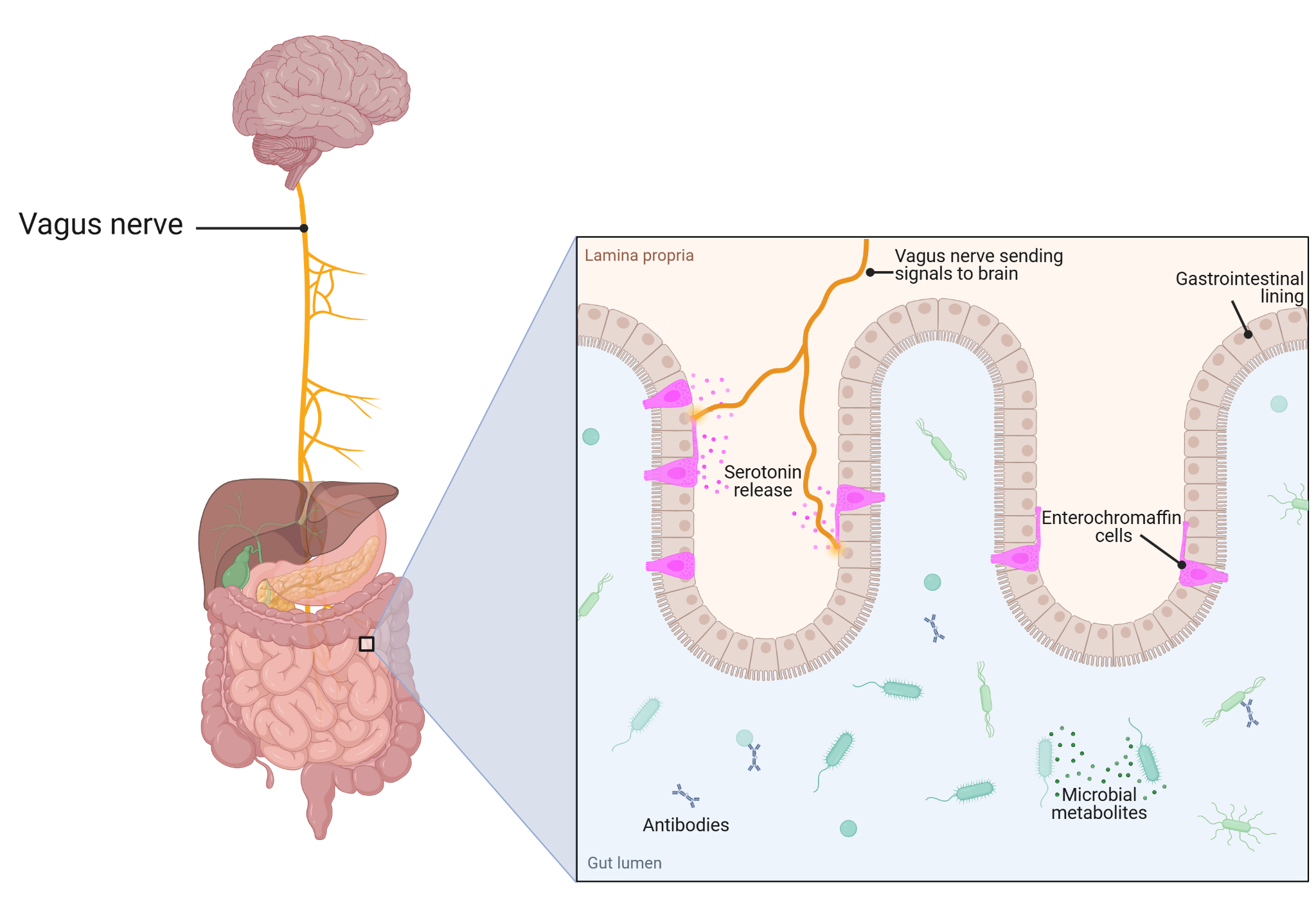
While it might seem strange to think of the digestive system talking to the brain, the two organs are linked by one of the most extensive communication networks in the body. This connection – known as the gut-brain axis – is a bidirectional, biochemical highway that allows the gut to influence brain function, and conversely, enables the brain to shape GI physiology (Figure 1). This ongoing dialogue within your body is more increasingly recognized as a contributor to cognition, mood, behavior, and overall health. (Cryan et al. 2019).
Serotonin: The Great Mediator
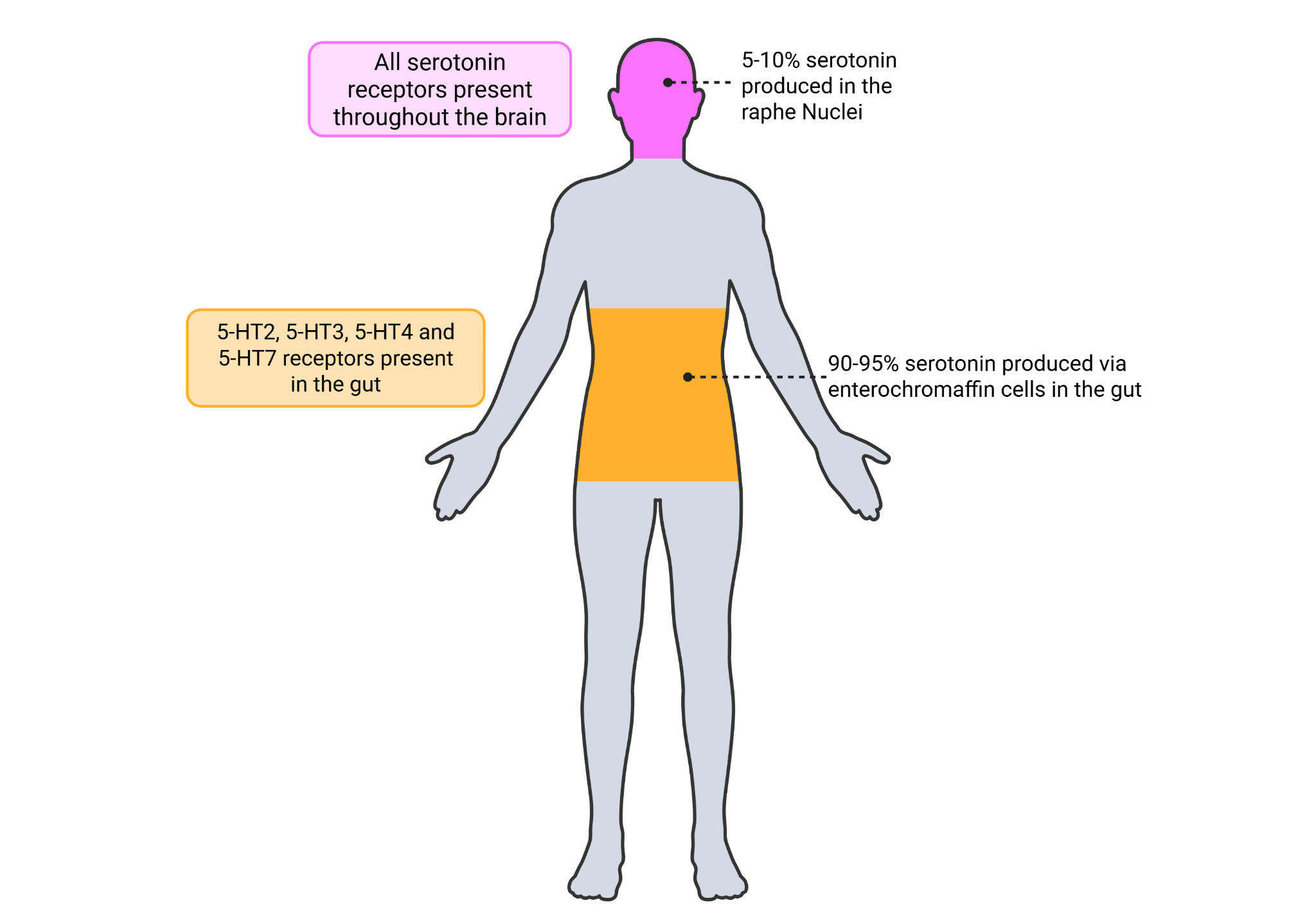
Serotonin is at the center of this connection. While generally known as a “brain-chemical”, 90-95% of the body’s serotonin is produced in specialized enterochromaffin cells that line the GI tract (Figure 2; Yano et al. 2015). Once produced, gut-derived serotonin regulates intestinal movements, gut immune responses, and signaling to the brain via the vagus nerve, a long cranial nerve that serves as the primary physical communication channel of the gut-brain axis (Kaelberer et al, 2018).
The vagus nerve runs from the brainstem all the way to the abdomen, carrying sensory information from the gut to the brain. The gut-derived serotonin acts on sensory nerve endings of the vagus, triggering signals that ascend and influence brain regions involved in mood, appetite, stress response, and emotional regulation (Kaelberer et al., 2018). In this way, events occurring in the digestive tract can shape neural activity and influence how we think and feel. This bidirectional communication helps explain findings that have long puzzled clinicians: why gastrointestinal disorders like irritable bowel syndrome (IBS) are so frequently accompanied by anxiety and depression, and why psychological stress so reliably disrupts gut function (Patel et al. 2024). Increasingly, evidence suggests that these conditions are not separate disorders occurring by coincidence, but rather manifestations of a tightly integrated gut-brain communication network.
The Power of the Microbiota
The growing appreciation for the gut-brain access has prompted an obvious question: if the gut microbiome can influence brain function, can changing the microbiome ecosystem alter behavior? One compelling approach to answering this question is demonstrated through fecal transplant studies, which involve altering the gut microbiome by transplanting fecal microbiota from one individual (or animal) to another.
In clinical studies, much of this work has been done in patients with IBS or other GI diseases. A systematic review found that, among studies evaluating depression and anxiety symptoms following fecal transplant treatments, all but one reported significant short term-improvements, with benefits lasting up to 6-months in some cases (Meyyappan et al. 2020). These findings suggest that manipulating the gut microbiome may influence not only GI health, but also emotional well being.
Researchers have begun extending these observations to disorders beyond the GI tract. In a phase I randomized clinical trial, fecal transplantation reduced alcohol craving and consumption in patients with alcohol use disorder (Bajaj et al. 2021). Follow-up studies demonstrated that the positive outcomes were dependent on live bacteria (not a germ-free preparation) and were associated with genetic alterations in the gut immune-inflammatory pathway (Wolstenholme et al. 2022). Together, these findings suggest that the microbiome can influence neural circuits involved in reward and addiction.
Evidence from animal models further supports a role for the microbiome in brain function. Building from last month’s discussion of critical periods, a recent preprint investigated whether an intact intestinal microbiota is required for critical period plasticity. Mice treated with antibiotics (disrupting the microbiome) during the critical period for ocular dominance exhibited impaired cortical plasticity. Remarkably, transplanting microbiota from healthy, non-impaired juvenile mice, into these impaired adults, restored cortical plasticity in the visual cortex (Damiani et al. 2026).
Although mechanisms underlying these effects remain under investigation, several pathways have emerged as leading candidates. One theory suggests that disruption of serotonin production on the part of antibiotics may have played a role in cortical plasticity deficits. In support of this, other studies have assessed prucalopride (a serotonin 5-HT4 receptor agonist) on behavior and gut microbiomes of stressed mice, demonstrating that it has greater efficacy to improve anxiety and depressive-like symptoms compared to fluoxetine (Cussotto et al. 2026).
Why this matters for Xylo Bio
For decades, mental health treatment has been focused almost exclusively on the brain. Yet the emerging science of the gut–brain axis suggests that many of the biological processes influencing mood, cognition, and behavior begin well beyond the central nervous system. Serotonin provides just one striking example of how closely interconnected the brain and body truly are.
As our understanding of these connections deepens, so does the opportunity to rethink how we approach neuropsychiatric disease. Rather than treating symptoms solely by targeting the brain, future therapies may restore the underlying biological networks that contribute to those symptoms—including communication among the gut, immune system, microbiome, and nervous system.
The gut–brain axis reminds us that the brain does not function in isolation. By understanding (and ultimately harnessing) the biological conversations occurring throughout the body, we have an opportunity to develop a new generation of therapies that treat neuropsychiatric disorders at their source.
XYLO BIO UPDATES:
Collaborations and Thought Leadership
- Dr. Liam Adair published a paper as corresponding author focused on development and access to fluorescent dyes with real applications, from readily available reagents using a simple one-step protocol, that can be followed by anyone with access to a chemistry lab. Read more here.
- Samantha Rector (Director of Business Development) attended the BIO International Convention in San Diego.
- In Xylo Bio’s recent Targeted Neuro Talks, Dr. Sam Banister chatted with Dr Hon Weng Chong, founder of Cortical Labs about wet-AI and growing field of neurotechnology.
Coming Up:
Find members of the Xylo Bio team traveling in the coming months:
- Xylo Labs Visit (June 29-July 7 Sydney, AUS) - Jack Nguyen (VP of Research and Development) will be visiting with the Australian team in person.
- 9th Neuropsychiatric Drug Development Summit (September 15-17 Boston, MA) - Dr. Sam Banister (CSO) will be presenting on the intersection of AI, drug discovery and neuronal biomarkers.
Photos

RESEARCH UPDATES: Science Shaping the Future of Neurotherapeutics
This month’s emerging literature demonstrates the same principles driving Xylo’s strategy: mechanism-guided design, rigorous biological investigation and clinically scalable innovation.
Preclinical Research
- Sex-dependent shifts in gut-brain signaling follow adolescent isolation | Investigating the impact of early-life social stress, researchers found that isolation during development triggered divergent responses in male and female rats. Females demonstrated a decline in microbiome diversity coupled with altered neuroplasticity-related gene expression in the brain, while males showed significant upregulation of intestinal immune markers. Both sexes exhibited increased colonic Tph1 expression, indicating that while serotonin pathways are universally affected, the broader immune and plastic responses to developmental stress remain highly sex-specific. Brain Behav. Immun. Health.
- 5-HT7 receptors may act as a regulator of post-heart attack immune responses | In this study, serotonin 5-HT7 receptor signaling was found to regulate immune responses and cardiac repair following myocardial infarction (heart attack). Genetic deletion of 5-HT7 receptors worsened inflammation and heart function, while pharmacological activation improved survival, suggesting that serotonin signaling through 5-HT7 may help coordinate post-infarction healing and represents a potential therapeutic target. J. Transl. Med.
- LSD potentiates the effects of targeted brain stimulation in rats | This study aimed to harness psychedelic-induced neuroplasticity to see if it could potentiate therapeutic effects of brain stimulation. When LSD was given 24-h prior, the effects of targeted brain stimulation were enhanced and prolonged. These effects were accompanied by activation of plasticity-related mTOR signaling and changes in perineuronal net integrity, supporting the idea that psychedelics may extend a window of neuroplasticity that can be harnessed to improve neuromodulation therapies. Brain Stimul.
- Psilocybin reduces microglial density and restores 5-HT2A signaling post-TBI | Researchers modeled traumatic brain injury (TBI) in mice and gave a single dose of psilocybin one year later to model psychedelic intervention in TBI. They found improved sensorimotor function, restored 5-HT2A receptor signaling on PET imaging, and reduced chronic neuroinflammation 24-h after dosing. These findings suggest that psilocybin may play a role in TBI recovery through simultaneously targeting persistent serotonergic dysfunction and neuroinflammatory processes. Cell Rep. Med.
- Psilocybin shows promise as an adjunct to gabapentin for pain relief | Using mouse models of neuropathic and chronic pain, researchers found a single dose of psilocybin reduced neuropathic pain behaviors for up to a month and significantly enhanced the pain-relieving effects of gabapentin, a commonly prescribed treatment for neuropathic pain. The findings suggest that psilocybin may produce lasting changes in pain-processing networks that both provide direct analgesic benefits and improve responsiveness to existing therapies. Commun. Biol.
Clinical Research
- Psychedelics produce similar effects on the DMN across species | Across four datasets in humans and mice, researchers found that MDMA, psilocybin, and LSD consistently reduced the magnitude and bottom-up flow of activity within the brain’s default mode network. These changes were associated with subjective drug effects, suggesting that psychedelics may alter conscious experience by dampening hierarchical information propagation in large-scale brain networks Proc. Natl. Acad. Sci.
- Pramipexole shows sustained effects in mood disorders in Phase IV trial | In a randomized, double-blind, placebo-controlled trial (n=82), the dopamine agonist pramipexole – approved for Parkinson’s Disease – significantly reduced anhedonia in patients with major depressive disorder, dysthymia, or bipolar depression and was generally well tolerated. Improvements were sustained during a 6-month open-label extension, supporting pramipexole as a potential adjunctive treatment for reward-processing deficits in mood disorders. Lancet Psychiatry.
- Oral DMT + Harmine produce significant effects in PET imaging study | In a single-blind, placebo-controlled crossover study (n=14 healthy males), oral DMT combined with harmine increased whole-brain glucose metabolism by 12.5%, with the largest effects observed in higher-order cortical networks measured using [18F]FDG-PET imaging. The findings suggest that heightened cerebral energy consumption may be a metabolic signature of the psychedelic state and extend similar observations previously reported with psilocybin. Neuropsychopharmacol.
- Audio-EEG provides insight into effects of LSD on auditory and motor activity | In a randomized, placebo-controlled crossover trial (n=45 healthy adults), a single 100 μg dose of LSD improved offline motor learning the following day and was associated with reduced perceived stress and greater cognitive flexibility one week later. EEG recordings revealed acute and persistent changes in auditory and motor cortical activity, suggesting that LSD may promote lasting neurophysiological adaptations that support learning and plasticity. Neuropsychopharmacol.
- High-dose psilocybin produces improvements in Alzheimer’s patient | In this observational case report (n=1), an 80-year-old woman with advanced Alzheimer’s disease experienced transient improvements in communication, continence, mobility, emotional responsiveness, and daily functioning following administration of 5 g of psilocybin-containing mushrooms. Further studies exploring this phenomena are warranted. Front. Neurosci.
Editorials and Reviews
- Serotonin type 3 receptor (5-HT3R) antagonists for negative symptoms and cognitive impairment associated with schizophrenia: a systematic review and meta-analysis | This systematic review and meta-analysis analyzed 12 placebo-controlled comparisons (n=730 participants) to assess the possible efficacy of 5-HT3 receptor antagonists, including several “setron” drugs and vortioxetine, in schizophrenia symptoms. They found these antagonists produced moderate improvements in both negative symptoms and cognitive impairment. The findings suggest that targeting 5-HT3 receptors may offer a promising adjunctive approach for symptoms that are often inadequately addressed by existing antipsychotic treatments. Neuropsychopharmacol.
- Beyond Symptoms: Early Predictive Biomarkers of Antidepressant Outcomes in Major Depressive Disorder | This narrative review examines emerging biomarkers that may help predict antidepressant treatment response in major depressive disorder, including measures of BDNF signaling, inflammation, cortisol, serotonin-related genes, gut microbiota, neuroimaging markers, and non-coding RNAs. While several biomarkers show promise for identifying patients more likely to respond to treatment, the evidence remains inconsistent, and no biomarker is currently validated for routine clinical use, highlighting the need for larger studies and multimodal precision psychiatry approaches. Curr. Neuropharmacol.
- Synaptic Actions of Estradiol in the Brain’s Reward System: Linking Mechanisms to Behavior and Disease | This review article examines how 17β-estradiol (E2) influences brain reward circuits and may contribute to sex differences in vulnerability to depression and substance use disorders. The authors propose that low E2 states may increase susceptibility to stress-related depression by dampening dopamine signaling, whereas high E2 states may heighten reward sensitivity and addiction risk, highlighting hormonal fluctuations as an important driver of psychiatric vulnerability across the lifespan. Biol. Psychiatry.
- Classic Psychedelics for Chronic Pain: A Critical Review of the Literature and Practical Advice for Clinicians | This review evaluates the emerging evidence for classic psychedelics as treatments for chronic pain highlighting potential mechanisms including neuroplasticity, anti-inflammatory effects, altered brain network dynamics, and improvements in pain acceptance and cognitive flexibility. While early observational studies and small clinical trials have reported benefits in conditions such as fibromyalgia, migraine, and cluster headache, the authors emphasize that larger, well-controlled randomized trials are needed before psychedelics can be considered evidence-based treatments for chronic pain. Drugs.
- Modulation of monoaminergic neurotransmission in substance use disorders: a neuropharmacological perspective focusing on plant-derived metabolites | This review article examines both preclinical and clinical evidence that plant-derived compounds from Hypericum perforatum (St. John’s wort), Rhodiola rosea, Withania somnifera (ashwagandha), and certain essential oils may modulate serotonin, dopamine, and norepinephrine signaling through multiple mechanisms relevant to substance use disorders. The authors propose that these compounds could serve as adjunctive treatments for addiction and co-occurring mood symptoms, but emphasize that stronger clinical evidence and standardized formulations are needed before therapeutic use can be established. Front. Pharmacol.
Clinical Trial Registrations
Below we highlight some of the newer clinical trial registrations via clinicaltrials.gov.
Diagnostic Test: SNP Genotyping and Gut Metagenomics | Major Depressive Disorder, Generalized Anxiety Disorder, PTSD, or Panic Disorder (N=30) | Serotonin Variants & Gut Microbiota in Mental Health | Sponsor: Neurobiologix | NCT07634458
Adderall | Post Traumatic Stress Disorder (N=40) | Effects of Stimulant Medications in PTSD (SMP) | Sponsor: University of Chicago | NCT07664631
Jump back to:
- Science in Sixty Seconds – Exploring the last year of neurotherapeutics
- Xylo Bio Updates – Company news, progress, and highlights
- Research Updates – Summaries of recent studies shaping the field
Thanks for reading Xylo Bio’s Neuroscience Newsletter! Subscribe to stay informed.

.webp)