November 2026 Newsletter
Science in Sixty Seconds
Over the last two issues we covered validity and the generalizability gap. This month we look at some of the tools that aim to bridge that gap: translational biomarkers.
What is a biomarker?
The term biomarker describes exactly what it sounds like: something in the body that can be measured, that consistently links to biology, a disease process or a response to an intervention (FDA-NIH Biomarker Working Group).
Think of a biomarker like a smoke detector: it signals that there is smoke, allowing you to figure out what’s wrong before a full-blown fire. In medicine, biomarkers can play the same role and help answer early questions that symptoms sometimes can’t. In drug development, biomarkers can also be used to ask whether the drug reaches its target, at what dose, and who is most likely to benefit or be harmed?
Through the Biomarker Qualification Program, the U.S. The Food and Drug Administration reviews data to confirm a biomarker reliably measures a specific biological process for drug development. For example, there are FDA-approved predictive biomarkers for immune checkpoint inhibitors in cancer. PD-L1, a measurable protein found on immune cells, was the first FDA-approved predictive biomarker for non-small-cell lung cancer (NSCLC) in 2015. Since then, the FDA has approved PD-L1 as a companion or complementary diagnostic test for six additional tumor types (Wang et al. 2021).
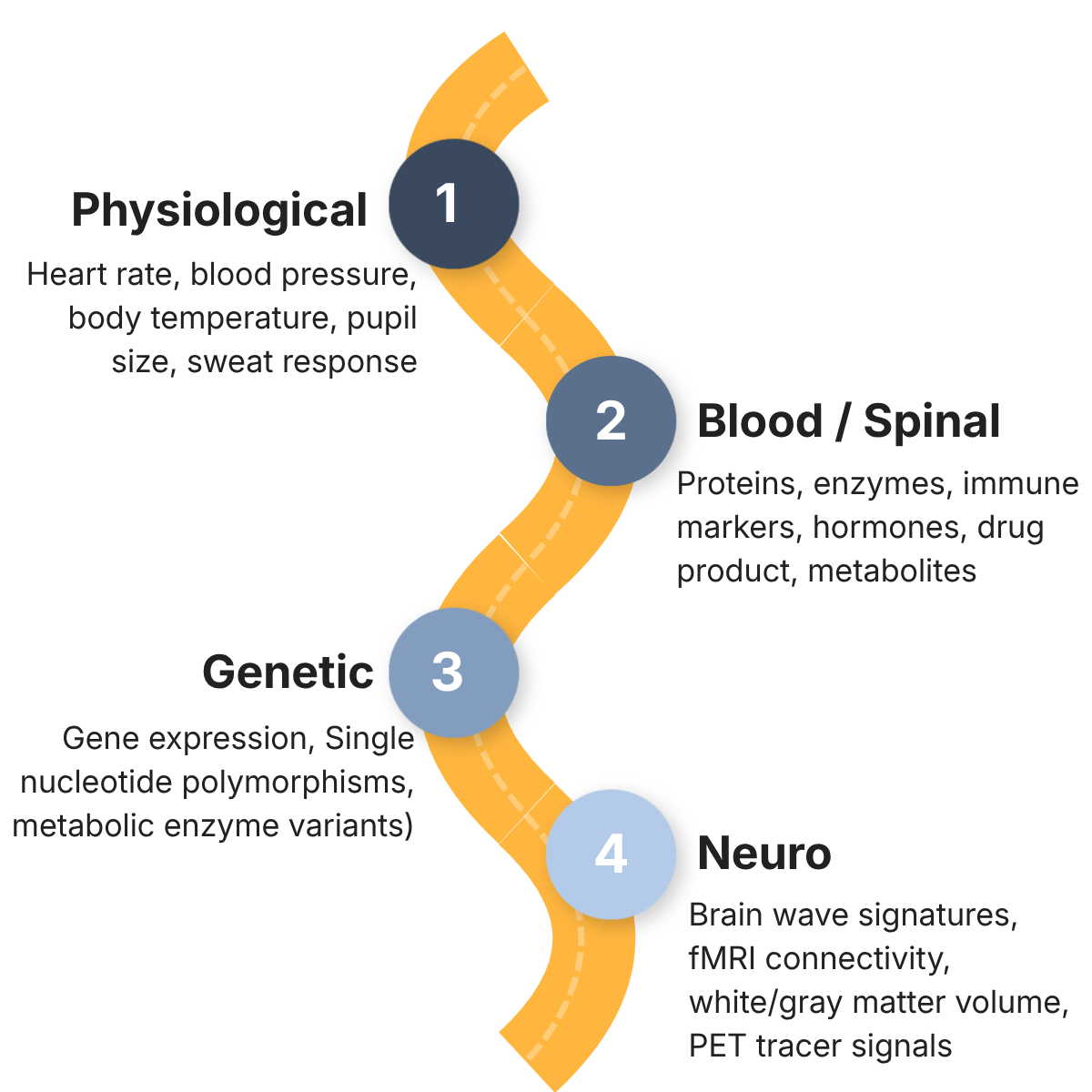
Biomarkers come from many places in the body, not just the brain, and can be useful for identifying what interventions work or how the body responds to specific treatments across disease states. We focus on four biomarker categories: physiological, blood or spinal fluid, genetic and neurological (Figure 1).
Physiological Biomarkers
A physiological biomarker is a bodily response that can be measured quickly in the clinic. These signals show that a drug is active in the body and help researchers track safety and compare doses, not to diagnose or treat. Psychedelics, for example, produce measurable changes in blood pressure, pupil size and stress hormones (Holze et al. 2022).
Blood Biomarkers
These markers can reflect nerve damage, inflammation or how much drug is circulating. These samples can be taken repeatedly over a trial or treatment to assess how much free compound is in the blood, or to evaluate how a patient is doing. Blood markers can be powerful enough to support approval: the amyotrophic lateral sclerosis drug, tofersen, received accelerated FDA approval based on lowering Neurofilament Light Chain (NfL), a blood marker of nerve damage (Miller et al. 2022; Nucleic Acid Ther. 2023). However, blood biomarkers are only currently established in some neurological diseases like ALS and Alzheimer’s. In psychiatry, inflammatory and other blood markers remain exploratory, in part because they aren’t specific to any one disorder.
Genetic Biomarkers
A genetic biomarker is a variation in someone’s DNA that affects how they would react to a drug or intervention. Unlike most biomarkers, it doesn’t change with treatment; it’s read once and can inform every treatment afterward. For example, CYP2D6, a key liver enzyme encoded by the CYP2D6 Gene which breaks down or activates roughly 25% of all commonly prescribed medications, are the best-established examples for a genetic biomarker. Clinical guidelines now use them to help choose and dose some antidepressants (Bousman et al. 2023), however the current use is only limited to understanding how the body processes a drug not for determining risk scores or predicting treatment response (Bousman et al. 2023). There are also biomarkers related to viral load in patients with HIV, which are measured directly via nucleic acid amplification tests for viral RNA/DNA. Measuring biomarkers like plasma-HIV-1 RNA can track virus replication, treatment response, and reach an “undetectable” status (Abdi et al. 2023).
Brain-based Biomarkers
A brain-based biomarker measures what’s happening in the brain itself measured through various techniques like fMRI, PET and EEG. Because the brain is where neurotherapeutics are meant to act, these tools are built with higher resolution to figure out just how the brain is adapting to treatments. Many of these can be measured the same way in animals and people, making them especially useful for translating lab findings to the clinic and potentially helping find better interventions for people with complex neurological illnesses like Parkinson’s Disease (Makhsous et al. 2026). However, there are currently no approved brain-based imaging biomarkers.
Not always straightforward…
In fields where clear biomarkers exist, like cancer and infectious disease, drug development is far more straightforward. Researchers can enroll the right patients, confirm a drug is working on its target, and track the disease objectively.
Psychiatry hasn’t had that advantage. Clinical trials still mostly enroll patients based on symptom checklists rather than underlying biology, and the same symptoms can show up across many different disorders. Despite decades of work, few psychiatric biomarkers have progressed beyond exploratory use likely due to the polygenetic nature of many psychiatric diseases. Widely studied candidates such as cortisol, C-reactive protein (CRP) and certain glutamate receptor gene variants looked promising in early studies but did not hold up in larger trials (Khalsa et al. 2026).
The job of a biomarker is to give a snapshot of the clinical effect with a direct target. If the biomarker moves but patients don’t improve, the drug may reach its target but the mechanism might not be as clearcut as initially thought. Lanicemine, an NMDA receptor antagonist that was studied for treatment resistant depression shows this clearly. EEG changes confirmed it was engaging NMDA receptors and helped guide dose selection (Sanacora et al. 2014), yet it did not separate from placebo in larger trials (Keavy et al. 2016).
The signals themselves are also hard to read but machine learning is starting to help. One algorithm analyzed EEG from 309 patients in a placebo-controlled trial and found a brain signature that predicted improvement on sertraline but not placebo, which held up in two other patient groups (Wu et al. 2020). Companies like Alto Neuroscience are built around this approach, using EEG, cognitive testing and wearable data to select patients (Alto Neuroscience), but results so far are mixed.
There are early signs of progress. An EEG measure of face processing and an eye-tracking measure of social attention, developed by an autism research consortium, became the first psychiatric biomarkers accepted into the FDA’s Biomarker Qualification Program. That is an entry point into a multi-step review, not a final qualification (McPartland et al. 2020).
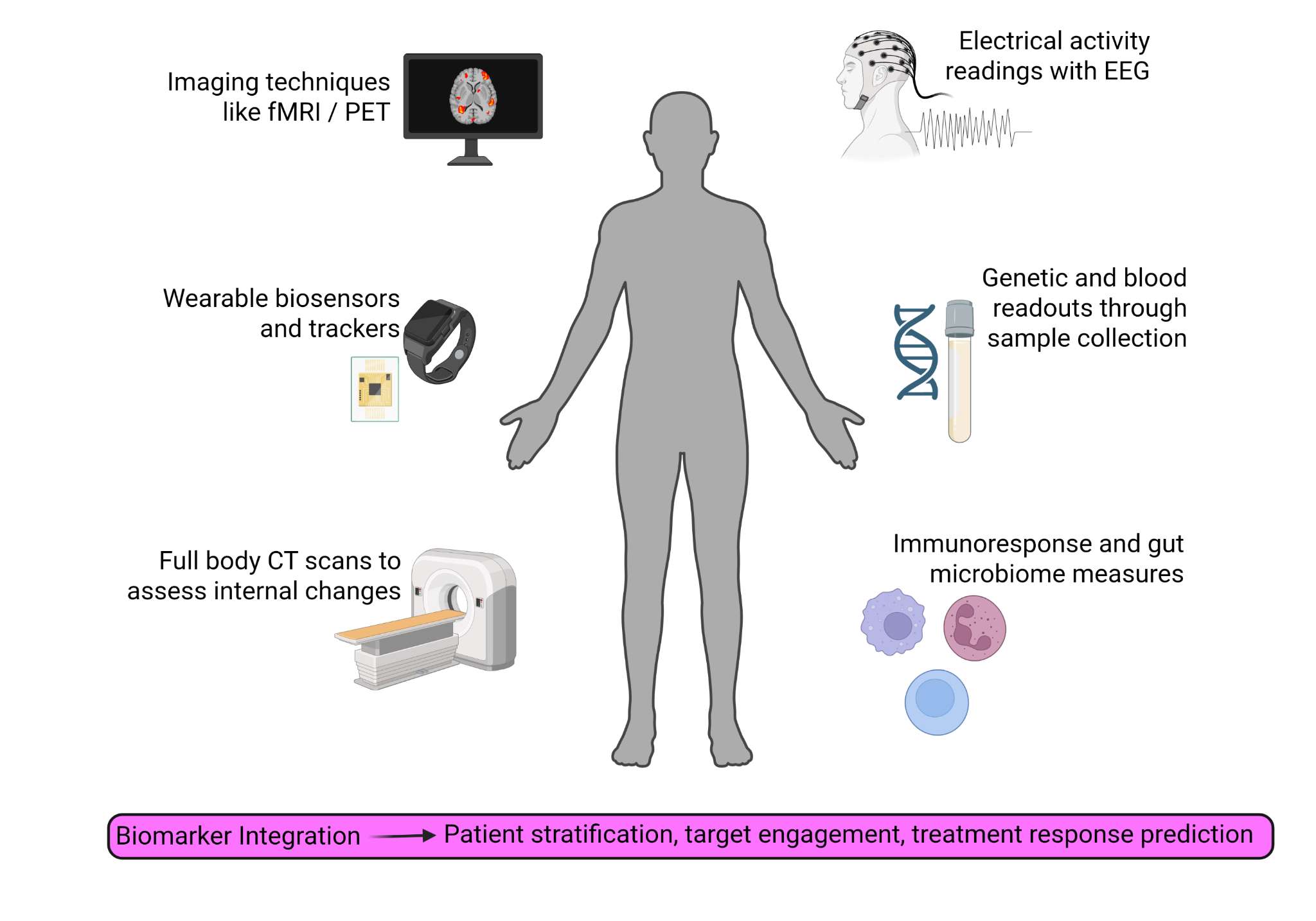
Most of the currently approved biomarkers remain specific for cancer treatment or tailoring medications based on blood levels, but several researchers are working to establish psychiatric biomarkers across a variety of technologies (Figure 2). As last issue’s ACNP position paper noted, most psychiatric biomarkers are still exploratory and need standardized methods and large shared datasets to mature (Khalsa et al. 2026).
Why this matters for Xylo Bio
As XYL-1001 moves through its Phase 1 study in healthy volunteers, measuring pharmacodynamic effects alongside safety and tolerability helps connect what we see in the lab to what happens in people. Using several kinds of measures across the brain and body is how we make sure we’re asking the right question at the right dose, before asking whether a treatment can help patients more broadly.
XYLO BIO UPDATES:
Collaborations and Thought Leadership
- Xylo Bio is thrilled to announce we have been selected to participate in the The National Institutes of Health (NIH) HEAL Initiative’s Preclinical Screening Platform for Pain (PSPP), administered by the National Institute of Neurological Disorders and Stroke (NINDS). Our inclusion in this competitive program is a strong signal for the rigour of our drug discovery pipeline. Learn more here.
- In the month of October, Xylo participated in the Hike for Mental Health’s hikeOctober challenge to raise money and awareness for research on mental health. We collectively raised $2,650 and hiked 296.4 miles, going above and beyond both of our goals!
- Co-Founder Josh Ismin attended Tenmile’s FocalPoint Health Innovation Forum as a part of AusBiotech week October 19.
- Dr. Banister (CSO) and Dr. Alaina M. Jaster (Head of Comms) attended the UW-Madison Psychedelic Symposium October 29-30.
- In Xylo Bio’s recent Targeted Neuro Talks, Dr. Sam Banister chatted with Dr. Eric Nestler, Ann and Joel Ehrenkranz Dean at the Icahn School of Medicine in Mount Sinai and a scientific advisor to Xylo Bio, whose work spans neuropsychiatry, behavioral neuroscience and epigenetics. They talk about the complexities of treating depression including sex differences in the brain, and more.
Coming Up:
Find members of the Xylo Bio team traveling in the coming months:
- JP Morgan Healthcare Conference (January 11-14 San Francisco, CA) - Various members of Xylo will be in attendance.
- Winter Conference on Brain Research (January 30-February 4 Breckenridge, CO) - Dr. Alaina Jaster will be attending.
Photos

RESEARCH UPDATES: Science Shaping the Future of Neurotherapeutics
This month’s emerging literature demonstrates the same principles driving Xylo’s strategy: mechanism-guided design, rigorous biological investigation and clinically scalable innovation.
Preclinical Research
- Reanalysis of 5-HT2A data challenges Gi signaling role | This scientific viewpoint found that Gi protein signaling is less reliable than other receptor pathways for distinguishing hallucinogenic from non-hallucinogenic compounds, challenging its use as a predictor of psychedelic effects and a guide for developing psychedelic-inspired treatments. ACS Chem. Neuro.
- Paraventricular thalamus involved in stress-enhanced fear learning circuit | This study found that the paraventricular thalamus, a brain region involved in processing stress and fear, plays a key role in heightened fear learning after traumatic stress in mice. Inhibiting this region 30 days after the initial stress prevented the mice from developing stronger fear responses to a later mild stressor. Front. Behav. Neurosci.
- α2 adrenergic receptor modulates behavioral effects of MDMA and psilocybin | Researchers report norepinephrine signaling can suppress psychedelic-like behavioral responses to 5-HT2A receptor activation in mice, helping explain why MDMA produces different effects from psilocybin. Notably, activating α2 adrenergic receptors reduced these responses while preserving psilocybin’s antidepressant-like effects. Mol. Psych.
- Single changes to molecules improve potency but may impair pharmacokinetics | NLX-101, a drug targeting postsynaptic 5-HT1A receptors was reported to improve working memory and cognitive flexibility in mice, following NMDA receptor antagonism. The findings explore how selectively targeting serotonin signaling may offer a potential approach to treating cognitive difficulties associated with neuropsychiatric disorders. Eur. J. Pharmacol.
Clinical Research
- Platelet proteins explored as a candidate biomarker for depression | This exploratory case-control study (N=40; 20 patients with major depressive disorder and 20 healthy controls) identified four proteins in platelet-enriched blood samples that may help distinguish people with depression from those without it. The findings offer potential leads for developing objective biomarkers for depression, but further research is needed to validate their diagnostic value. J. Affect. Disord..
- Peripheral immune markers may serve as a predictor for depression symptom improvement | This randomized controlled trial of adults with major depressive disorder (N=222) assessed inflammatory markers as predictors of depressive symptoms. They found that higher levels of inflammatory markers, including IL-6, TNF-α, and IL-1β, were associated with less improvement in depressive symptoms over eight weeks of sertraline or placebo treatment. Psychoneuroendocrin.
- Sex-dependent responses to bupropion and repeated rTMS |This randomized, sham-controlled study (N=40) found that adding repetitive transcranial magnetic stimulation (rTMS) to bupropion treatment improved sexual function and cognitive performance in women with major depressive disorder, compared with sham treatment. Depression symptoms improved in both groups, while sexual dysfunction in men decreased regardless of whether they received active rTMS. J. Psychiatr. Res.
- Women potentially more sensitive to microdosing effects of LSD or 2C-B than men | This preprint describes a pooled analysis of two randomized, placebo-controlled studies in healthy volunteers. They found that women reported stronger acute subjective effects and greater perceived impairment after taking psilocybin, LSD, or 2C-B than men, despite similar drug concentrations. BioRxiv.
Editorials and Reviews
- Are psychedelics anti-inflammatory? A systematic review and meta-analysis of studies examining the immunomodulatory effects of serotonergic psychedelics | This systematic review and meta-analysis (N=61) found that most laboratory and animal studies reported anti-inflammatory effects of serotonergic psychedelics. However, findings from human studies were mixed, with only 3 of 10 trials reporting anti-inflammatory effects. Brain Behav. Immun.
- Serotonin biology as a basis for explaining psychedelic drug action | This review examines how psychedelics affect the brain through serotonin signaling, focusing on reward learning, visual processing, and blood vessel function in the brain. The authors compare psychedelic effects with serotonin’s natural activity to explain how these drugs influence brain circuits and behavior. Curr. Biol.
- Could chronic estradiol deficiency contribute to suicide risk in anorexia nervosa? | This review proposes that low estradiol levels associated with anorexia nervosa may contribute to elevated suicide risk by altering serotonin signaling, beyond the effects of malnutrition and other psychiatric conditions. The authors highlight gaps in current evidence and outline research steps to test this hypothesis, noting that no completed hormone-intervention study in anorexia nervosa has specifically evaluated suicide-related outcomes. Biol. Psychiatry.
- The Neurochemical Basis of High-Altitude Sleep Disruption: Disentangling Respiratory and Sleep-Circuit Mechanisms Toward Targeted Pharmacotherapy | This review argues that treating breathing instability alone is insufficient to restore sleep at high altitudes. Disrupted serotonin, adenosine, orexin, and norepinephrine signaling may also contribute to sleep disturbances, suggesting that effective treatments must target both breathing regulation and the brain circuits controlling sleep. Curr. Neuropharmacol.
Clinical Trial Registrations
Below we highlight some of the newer clinical trial registrations via clinicaltrials.gov.
Lumateperone | Phase 4 | Major Depressive Disorder (N=30) | Lumateperone Added to Antidepressant Therapy in Adults With Major Depressive Disorder Experiencing Emotional Blunting | Sponsor: Future Options Research, LLC | NCT07824206
Ketamine (0.5 mg/kg) + BAT | Phase 2/3 | Treatment Resistant Depression (N=60) | Behavioural Activation Therapy and Ketamine for Treatment-Resistant Depression | Sponsor: The Royal’s Institute of Mental Health Research | NCT07801703
Jump back to:
- Science in Sixty Seconds – Exploring the last year of neurotherapeutics
- Xylo Bio Updates – Company news, progress, and highlights
- Research Updates – Summaries of recent studies shaping the field
Thanks for reading Xylo Bio’s Neuroscience Newsletter! Subscribe to stay informed.
This newsletter is for general educational and informational purposes only. Xylo Bio’s compounds are investigational and have not been approved by the FDA for any use; nothing discussed here should be taken as a claim about their safety or efficacy. Nothing in this newsletter or Xylo Bio’s Targeted Neuro Talks is medical, legal, or investment advice, and nothing here is an offer to sell or a solicitation. Statements about future plans, timelines, or outcomes are forward-looking, reflect current expectations only, and are subject to change.

